






From Neem Leaf to Your Cream: How NEEMAVERA® Is Made on Our Farm in Paraguay
Every one of our products contains NEEMAVERA®, our own active ingredient made from neem leaves. But where do these leaves actually come from, and how does a neem leaf become an ingredient that sensitive skin can trust? Come with us on the journey: from our neem farm in Paraguay, via extraction in Germany, all the way to your cream.
The key facts at a glance
- Our neem leaves come exclusively from our own farm "El Retiro" in the Paraguayan Chaco, which at 22,000 hectares is the largest neem plantation in the world.
- We grow the seedlings from the seeds of our own trees; we never buy in leaves.
- The leaves are collected when the trees are pruned and are gently dried within two days.
- In Germany, we use a patented, solvent-free CO₂ process to turn them into our active ingredient NEEMAVERA®, up to 50 times more concentrated than the dried leaf.
- Before the extract goes into a cream, it is tested for allergens, heavy metals, pesticides and other substances.
What is the neem leaf?
The neem tree (Azadirachta indica) originally comes from India and belongs to the mahogany family. It is evergreen, grows quickly and copes remarkably well with heat and drought. Its feathered leaves with their serrated edges have been used in the Ayurvedic tradition for centuries, above all in skin and oral care. You can read more about the plant in the article What is neem?.
The difference between leaf and oil is important: neem oil is pressed from the seeds, has a very intense smell and contains a lot of azadirachtin, a substance that is also used as a natural pesticide. For our skincare, we use only the leaves. We explain why in detail in Neem oil vs. neem leaf extract.

Our neem farm in Paraguay
How it all began
In 2013, we bought land in the Paraguayan Chaco, near Mariscal Estigarribia. What began as an investment quickly became a reforestation project on former pastureland. We deliberately chose the neem tree for this: it is robust, evergreen and copes with the extreme local climate. Today, on our farm "El Retiro", we manage the largest neem plantation in the world, covering 22,000 hectares. That is about two thirds of the area of Munich.
When we launched our blog series at the beginning of 2023, we had already planted more than 150,000 neem trees as part of the reforestation project. At that time, around 8,500 cattle grazed between the rows of trees. The trees give them shade, and their dung fertilises the soil: a cycle from which both sides benefit.
At that time, around 150 people lived on the farm, including their families, and 20 of them worked full-time in the tree nursery, cultivation, harvesting and processing. In this way, the farm creates good jobs in the region, including for women. So that the children do not have to go to a boarding school far away, a school was built right on the farm.
From seed to tree
Every step, from harvesting the seeds to planting in the field, is documented. This allows us to trace where every leaf comes from.

- Harvesting the seeds: When the trees bear fruit, the fruit is harvested.
- Tree nursery: The kernels are placed in small containers and raised in our tree nursery, protected from the blazing sun. After a few days, the first seedlings sprout.
- Repotting: As soon as they form leaves, they move into larger pots and are tended for around three months.
- Off to the field: They are taken to the planting area on trailers.
- Planting: A tractor with a drill and GPS sets the planting holes in straight rows with enough space between them, because the seedlings will grow into large trees.
- Taking root: In the first year, the young trees are watered until their roots can supply them on their own. The water comes from rainwater collection ponds and from wells with a desalination plant, and the electricity for this comes from solar panels on the farm.
After about a year, the seedling has become a small neem tree.
From neem leaf to raw material
Harvesting during pruning
Neem trees grow quickly and need to be pruned regularly. Every year, this produces large quantities of branches and leaves. What would end up as green waste elsewhere is our most valuable raw material: NEEMAVERA® is made from exactly these leaves.

Washing, drying, grinding
In our production hall on the farm, the leaves are first washed to remove dust and impurities. They are then dried within two days in specially built drying boxes. This is done deliberately gently, because the valuable leaf compounds are sensitive to heat. Finally, the dried leaves are ground, packed and shipped to Germany.

From raw material to NEEMAVERA®: CO₂ extraction in Germany
For skincare, we are not interested in the leaves as a whole, but in certain plant compounds they contain, for example nimbolide and other so-called limonoids. To make them available in concentrated form, we extract them in Germany using supercritical CO₂.
In this process, carbon dioxide is brought under high pressure into a state between gas and liquid, in which it selectively dissolves the desired compounds from the leaf powder. Afterwards, the CO₂ evaporates completely. The advantages: the process works without solvents, operates at low temperatures and leaves no residues. Our own process parameters are patented.

The result is a dark green, viscous extract that smells of freshly cut leaves. The relevant plant compounds in it are up to 50 times more concentrated than in the dried leaf. The extract is then standardised to a fixed value so that every batch has the same quality. You can read what NEEMAVERA® does for your skin in the article NEEMAVERA®: effects, studies and experiences.
Tested before it goes into the cream
Before NEEMAVERA® goes into a product, it is thoroughly tested, by us and by independent testing laboratories:
| Test | What it is about |
|---|---|
| Allergens | Analysis for known fragrance allergens according to the IFRA standard |
| Azadirachtin | Content of the substance that occurs mainly in neem oil and is known as a pesticide |
| Salannin | another typical neem compound that is monitored |
| Heavy metals | Ruling out contamination from the soil or processing |
| Pesticides | Ruling out residues |
| Skin compatibility | In vitro study and clinical study with Dermatest |
In an in vitro study on 3D skin models, Dermatest confirmed the skin compatibility as well as the antioxidant and anti-inflammatory properties of NEEMAVERA®. Find out more in our article on the in vitro study. Our care cream was also tested in a clinical study with Dermatest; you can find the results in the article Dermatologically tested.
From extract to finished cream
Our formulations are developed in Munich, and the products are manufactured by an experienced partner in Germany. A cream is made from two phases: the water-soluble ingredients are dissolved in the water phase, and the fat-soluble ones, including NEEMAVERA®, in the oil phase. The two phases are combined with an emulsifier to form an even cream. Each product then undergoes the legally required safety assessment as well as stability and preservative efficacy tests.
Then the cream is ready for its final journey: from our warehouse to your home. Because we are in control of every step ourselves, from cultivation and harvesting through to formulation, we know exactly what goes into our skincare.
Experience NEEMAVERA®
Our neem active ingredient is in all of our products, specially developed for very dry skin prone to psoriasis, atopic dermatitis or rosacea. Particularly good for getting to know it:
- Cream: light basic care for face and body, without fragrances
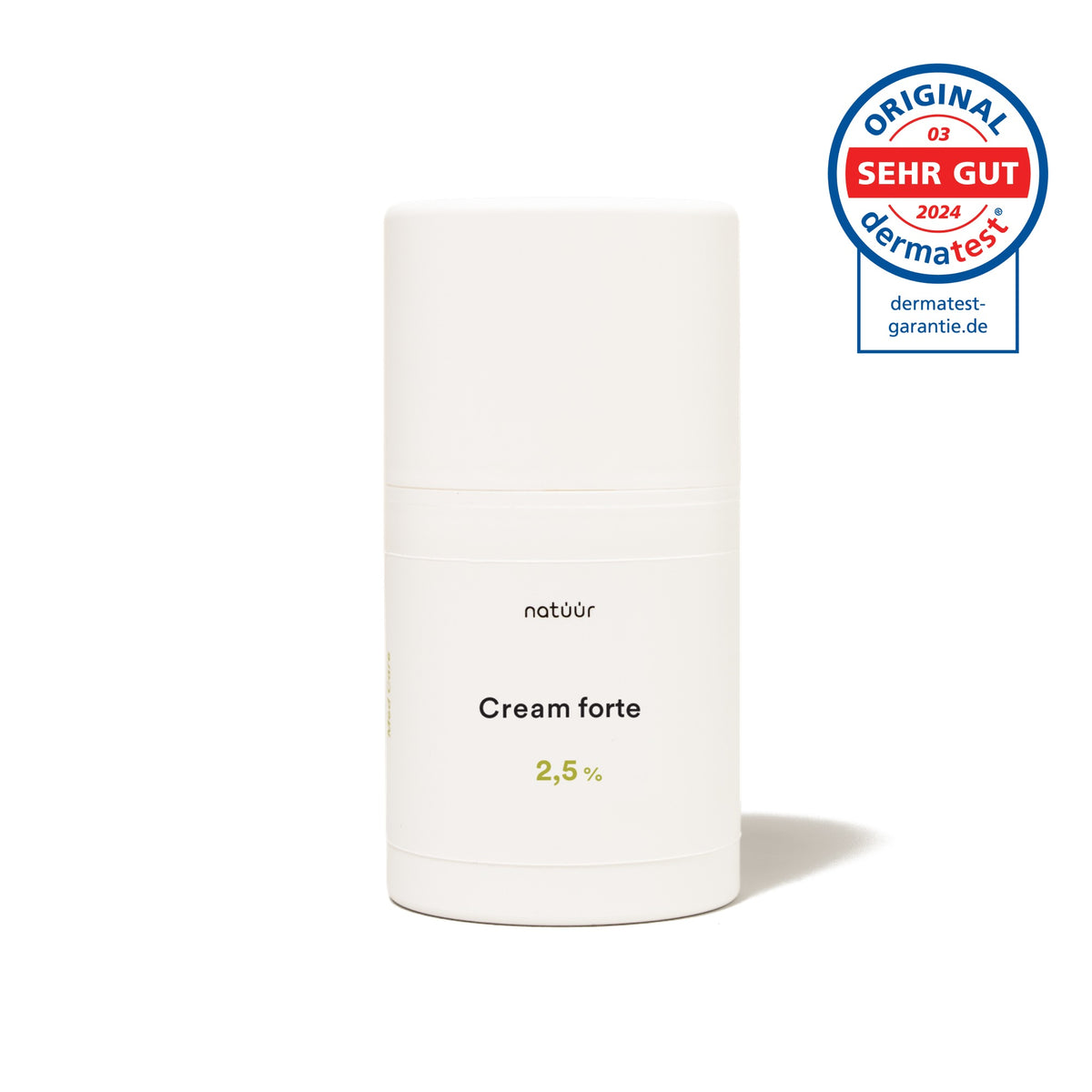
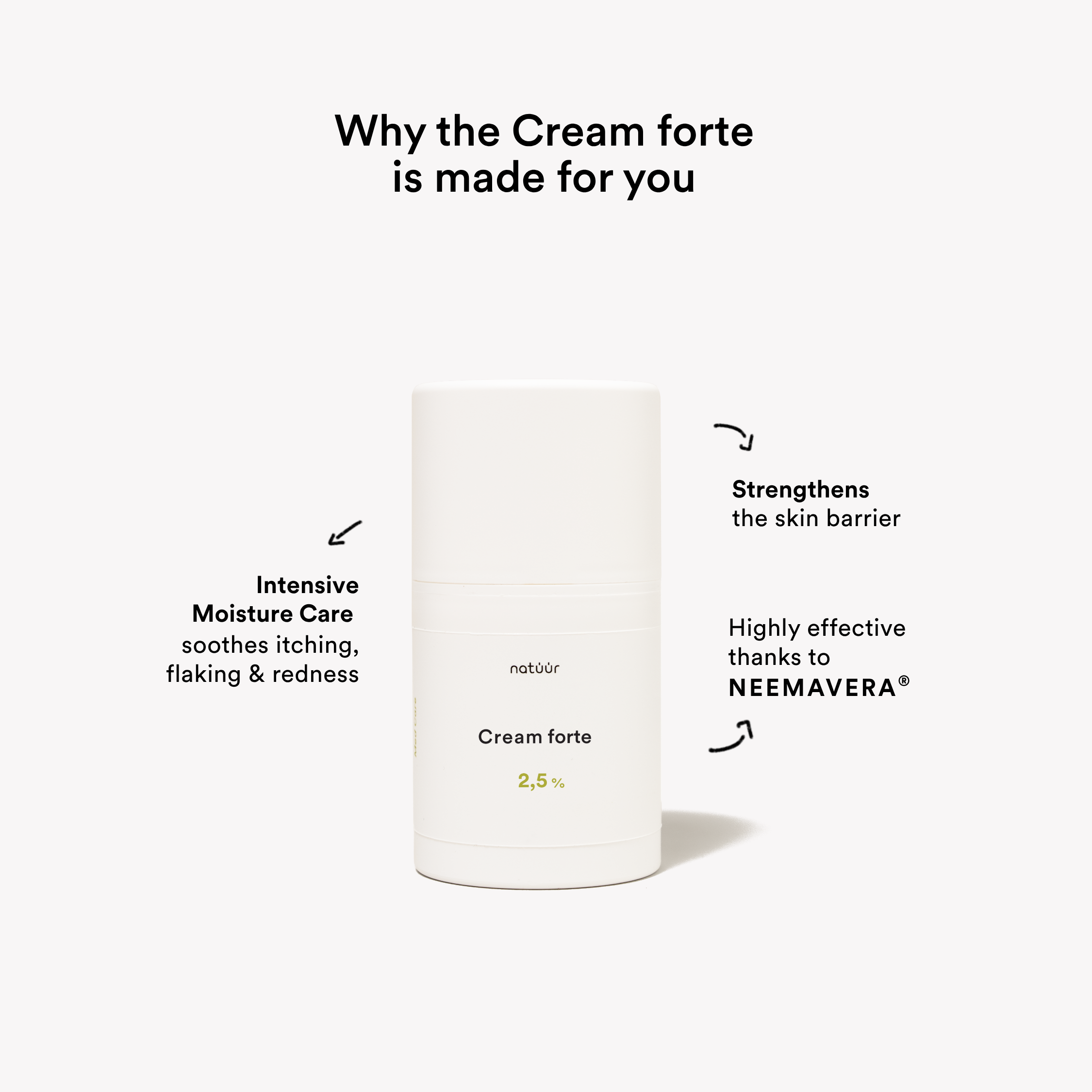
- Cream forte: rich care for very dry, scaly skin, without fragrances
You can find out more about our active ingredient on the NEEMAVERA® page, and more about us under About us.
Frequently asked questions
Where do natüür's neem leaves come from?
Exclusively from our own farm "El Retiro" in the Paraguayan Chaco. At 22,000 hectares, it is the largest neem plantation in the world. We do not use bought-in leaves.
What is the difference between neem leaf and neem oil?
Neem oil is pressed from the seeds, has a very intense smell and contains a lot of azadirachtin. For NEEMAVERA®, we use only the leaves, without seed oil.
How is NEEMAVERA® made?
The leaves are washed, gently dried and ground on the farm. In Germany, we use a patented, solvent-free CO₂ process to obtain the relevant plant compounds from them, up to 50 times more concentrated than in the dried leaf.
Why CO₂ extraction?
The process works without solvents and at low temperatures. This preserves heat-sensitive plant compounds, and no solvent residues remain in the extract.
How is the extract tested?
Among other things, for allergens, azadirachtin, salannin, heavy metals and pesticides. Skin compatibility was also investigated in studies with Dermatest.