






Nail Psoriasis (Psoriasis of the Nails): Symptoms, Causes & What Helps
In brief: Nail psoriasis is psoriasis of the nails and shows up mainly as nail pitting, yellowish-reddish oil drops, and lifting or thickened nails. It is not contagious, but it often looks confusingly similar to nail fungus, which is why it should be checked by a dermatologist, ideally with a fungal test. Depending on how severely the nails are affected, topical treatments, injections or systemic therapy can help, and because nails grow slowly, every treatment takes patience. In everyday life, one thing matters most: as little irritation as possible for the nail and cuticle. And because nail changes can point to joint involvement, it is worth keeping an eye on your fingers and toes.
Small dents in the nail, a yellowish spot underneath, a corner that comes loose: changes to your fingernails or toenails are unsettling, especially if you don't know whether it is psoriasis, nail fungus or something else entirely. Here you will find out how to recognise nail psoriasis, how it differs from nail fungus, what helps medically, how to protect your nails in everyday life and when you should follow up with a doctor.
What is nail psoriasis when psoriasis affects the nails?
Nail psoriasis is not a separate disease but psoriasis on the nail. Behind it is the same chronic inflammatory condition as on the elbows or scalp: the immune system drives inflammation, and as a result the nail cells renew themselves far too quickly (Source: S3 guideline Therapy of Psoriasis vulgaris, AWMF). You only see the result weeks later, because a nail grows slowly.
How nail psoriasis changes the nail matrix and nail bed
What matters is where the inflammation sits. The nail matrix is the factory beneath the cuticle, where the nail plate is formed. The nail bed is the base on which the finished plate rests. Two locations, two completely different pictures:
| Feature | Nail matrix | Nail bed |
|---|---|---|
| Location | beneath the cuticle, nail root | beneath the nail plate |
| What is disrupted | formation of the nail plate | adhesion and keratinisation |
| Typical signs | nail pitting, white spots, transverse ridges, crumbling nails | oil drops, onycholysis, keratin build-up, splinter haemorrhages |
This distinction is not a textbook detail. It helps determine which treatment your dermatologist can sensibly use at all, because matrix involvement has to be tackled at the root and nail bed involvement beneath the plate.
How often psoriasis affects the nails
More often than many people think. Depending on the study, around half of people with psoriasis on the skin also show changes to their nails, and in psoriatic arthritis it is up to 80 percent (Source: Clin Rev Allergy Immunol, 2021). And in a small number of people, psoriasis shows up exclusively on the nail, without a single plaque on the skin. It is exactly these cases that are mistaken for nail fungus for a long time.

Nail psoriasis symptoms: how to recognise typical changes
Nails grow slowly, and that is precisely why they tell a story. What becomes visible at the tip of the nail today is often inflammation that began in the nail root months ago. The symptoms of psoriasis of the nails can be roughly divided into two groups: signs from the nail matrix (where the nail plate is formed) and signs from the nail bed (the base on which the plate rests).
What symptoms appear in the early stage of nail psoriasis?
At the beginning it is unspectacular. Really. Often there are just a few small dents, mild white discolouration in the nail plate (leukonychia) or slight redness of the nail fold, the fold of skin around the nail. Many people put it down to knocking a finger while closing a door. What is typical of psoriasis on the nails is that several nails are affected at the same time and fairly symmetrically, not just the big toe on the left. If you are unsure how to interpret a change, an AI skin analysis to identify skin changes can give you an initial assessment, but it does not replace a check by a dermatologist.
Nail pitting in nail psoriasis: small dents in the nail plate
Nail pitting is the best-known sign and originates in the upper nail matrix. There, cells keratinise incorrectly (parakeratosis), forming tiny, loose plugs of keratin that move forward with the nail and eventually fall out. What remains is the pinpoint dent. Picture a piece of brickwork in which individual bricks were never properly fired: they later crumble out and leave holes.
Oil drops, salmon colour and discolouration under the nail
Oil drops do not sit in the nail plate but beneath it. Inflamed areas in the nail bed collect keratin material and the fine blood vessels widen, which shows through the translucent nail as a yellowish to salmon colour. Hence the second name: salmon patch. Dark red to brownish lengthwise streaks are splinter haemorrhages, small bleeds from the capillaries.
Onycholysis, crumbling nails and thickened nails
When the nail separates from its base, this is called onycholysis. It usually starts at the free edge of the nail, caused by inflammation in the hyponychium, the transition zone beneath the tip of the nail. Notably, it usually doesn't hurt, but it is clearly visible as a whitish, lifted area.
Telling them apart is worthwhile, because the treatment approaches start in different places:
| Sign | Place of origin | Visible as |
|---|---|---|
| Pitting | Nail matrix | pinpoint dents |
| Oil drop | Nail bed | yellow-reddish spots |
| Onycholysis | Hyponychium | lifted nail edge |
| Crumbling nail | Matrix and nail bed | thick, disintegrating plate |
Crumbling nails are the late-stage picture: massive excess keratin material beneath the nail (subungual hyperkeratosis) lifts and destroys the plate, and the nail thickens and crumbles away. By this point at the latest, the finding belongs in the hands of a dermatologist.

Nail psoriasis or nail fungus: how to tell the difference
Yellow nail, crumbly edge, lifted tip. Nail fungus, right? Maybe. But maybe also psoriasis of the nails that just happens to look exactly the same. The two pictures overlap so much that even trained eyes can get it wrong, and that is exactly why it pays to look at the details.
Psoriasis nails and nail fungus compared directly
A few features point more towards one side or the other. The table shows what dermatologists look at first:
| Feature | Nail psoriasis | Nail fungus |
|---|---|---|
| Starting point | Nail root or nail bed | free edge of the nail |
| Typical sign | Nail pitting, oil drops | yellowish-white thickening |
| Cuticle | often red, swollen | usually unremarkable |
| Contagious | no | yes |
Pinhead-sized dents in the nail plate and yellow-brownish discolouration beneath the nail are considered key symptoms of psoriasis, whereas a fungus typically starts at the edge and eats its way backwards. The fundamental difference, however, lies deeper: psoriasis is a chronic inflammatory condition in which the immune system drives inflammation. Nail fungus is an infection with dermatophytes, yeasts or moulds and is therefore transmissible. You can find more about this mix-up in our article on the most common psoriasis myths.
Why a medical diagnosis with a fungal test is important
Visually, it is often impossible to tell them apart with certainty. That is why, in the practice, nail material is taken and examined: microscopy, fungal culture or a molecular PCR test. Why go to the trouble? Because taking the wrong path is costly. Anti-inflammatory treatments for undetected fungus let the pathogen keep growing, while antifungals for pure psoriasis of the nails simply do nothing. Months pass, and the nail stays as it is.
When nail psoriasis and nail fungus occur at the same time
It can also be both. A double infection is not uncommon, because the damaged nail offers fungi an entry point. The usual approach is then to treat the fungal infection first in a targeted way and afterwards tackle the anti-inflammatory management of the psoriasis. Take photos of your nails to your next appointment, ideally over several weeks, and ask directly for a fungal test.

Causes and triggers of nail psoriasis
The nail is not a part of the body that simply goes off the rails. Behind nail psoriasis is the same chronic inflammatory condition as behind the plaques on the elbows or scalp: the immune system drives inflammation, and the nail matrix then produces keratin too quickly and with structural defects. The predisposition for this is something you are born with. What determines when it shows up are the triggers.
What are the triggers of nail psoriasis?
Roughly speaking, there are two groups: stimuli that come from within, and those that act directly on the nail. Systemic triggers include psychological stress, infections (especially bacterial ones) and certain medications that can set off a flare-up. Added to these are the factors that generally play a role in psoriasis and that are partly in your own hands, such as dry skin, irritants or a strained gut. There is a separate article on the link between digestion and inflammation on the underestimated power of the gut in psoriasis, and if you want to know what else can tip your skin over the edge, you will find 10 triggers for sensitive skin here.
Koebner phenomenon: why pressure, friction and micro-injuries can encourage flare-ups
The Koebner phenomenon, also known as the isomorphic response, describes an unpleasant mechanism: on otherwise healthy skin or a healthy nail, exactly the typical psoriasis changes develop after mechanical irritation. The injury is the spark, the inflammation is already lying in wait.
Typical irritants around the nail are:
- overly thorough manicures and cutting away the cuticle, which is meant to act as a protective barrier
- nail biting and picking at the nail fold
- shoes that are too tight and press against the toenails with every step
- repeated knocks during manual work, gardening or sport
That is why consistently protecting your nails from pressure and microtrauma is the lever that is genuinely yours in everyday life. File them shorter instead of cutting. Gloves for cleaning and gardening. And shoes that leave room at the front.

Nail psoriasis treatment: what can help medically
Nails are not skin. They are a hard plate over the inflamed tissue, and that is exactly what makes treating nail psoriasis so slow going. Active ingredients either have to get through the nail plate or reach the nail bed from below. Which option is right is decided by your dermatologist, not by a look online.
How can nail psoriasis be treated?
Broadly, there are three routes: applying something to the outside, injecting locally, and working from within. Which one is chosen depends on how severely the nails are affected. To classify severity, specialists use the NAPSI, the Nail Psoriasis Severity Index, which assesses changes to the nail matrix and nail bed separately. A score is not an end in itself: it makes visible whether anything is changing over the months.
| Approach | Typical for | Things to note |
|---|---|---|
| Topical (cream, solution, lacquer) | individual nails, mild involvement | active ingredient has to get through the nail plate |
| Local injection | stubborn individual nails | in the practice, can be unpleasant |
| Systemic | several nails, skin or joint involvement | regular medical check-ups |
Topical therapy with cortisone, vitamin D3 analogues and medicated lacquers
For mild involvement, high-potency corticosteroids and vitamin D3 analogues such as calcipotriol come first, often in combination. Medicated nail lacquers, for example based on water-soluble chitosan, are intended to strengthen the nail plate and improve the penetration of active ingredients. They are carriers, not cosmetics.
Injections and local procedures for stubborn nail psoriasis
If nothing happens with topical treatment, cortisone can be injected directly near the nail matrix or nail bed. The advantage is obvious: the active ingredient doesn't have to penetrate the hard plate in the first place. This is usually only done on a few nails.
Systemic treatment with tablets, biologics or modern active substances
If several nails are affected, treatment from within becomes an option. Biologics such as IL-17, IL-23 or TNF-alpha inhibitors intervene specifically in the inflammatory process in which the immune system drives inflammation, and work on both skin and nails (Source: S3 guideline Therapy of Psoriasis vulgaris, AWMF).
And then: wait. Nails grow slowly, and the damaged section first has to grow out before you can even judge whether something is working. So note down a date at your next appointment and photograph your nails, always in the same light. It takes five minutes and beats relying on memory every time.

Nail psoriasis care: what you can do yourself in everyday life
Medical treatment does the actual work. What you do at home still makes a difference, though: every microtrauma to the nail bed can trigger new lesions via the Koebner phenomenon. Caring for nail psoriasis therefore means one thing above all: as little irritation as possible.
Gentle nail care for psoriasis of the nails
Clippers create pressure and stress cracks, a file doesn't. For brittle or thickened nails, glass files or fine emery boards are gentler than scissors and nippers. These points belong in your basic kit:
- Keep nails short and file in one direction, don't saw back and forth
- Never clean under the nail with pointed objects: that is exactly what encourages separation from the nail bed
- Don't cut the cuticle, just oil it and push it back gently
- Gloves for cleaning and washing up, roomy shoes for the toenails
In winter especially, dry heated air adds to the problem, more on this in the article on psoriasis in winter.
Nail polish, artificial nails and remover: what makes sense?
Coloured polish is allowed. Really. If you want to conceal nail pitting or oil drops, you can use breathable or water-based polishes sparingly. An acetone-free remover is then a must, because acetone draws moisture and lipids from the nail plate and surrounding skin, which makes brittleness and cracks worse. Hands off gel and acrylic nails, on the other hand: filing them off damages the nail plate, and acrylates can cause irritation and allergies.
Home remedies, oils and moisturising care for nail psoriasis
Long baths soften the nail, and as the water evaporates it takes extra moisture with it. Rich, water-free formulations make more sense. Plant oils such as jojoba, macadamia and castor oil provide care with lipids that keep the cuticle and nail plate more supple. A nourishing nail oil massaged in in the evening is quicker than any home remedy ritual, and you will find an overview of further approaches under seven natural remedies for psoriasis.
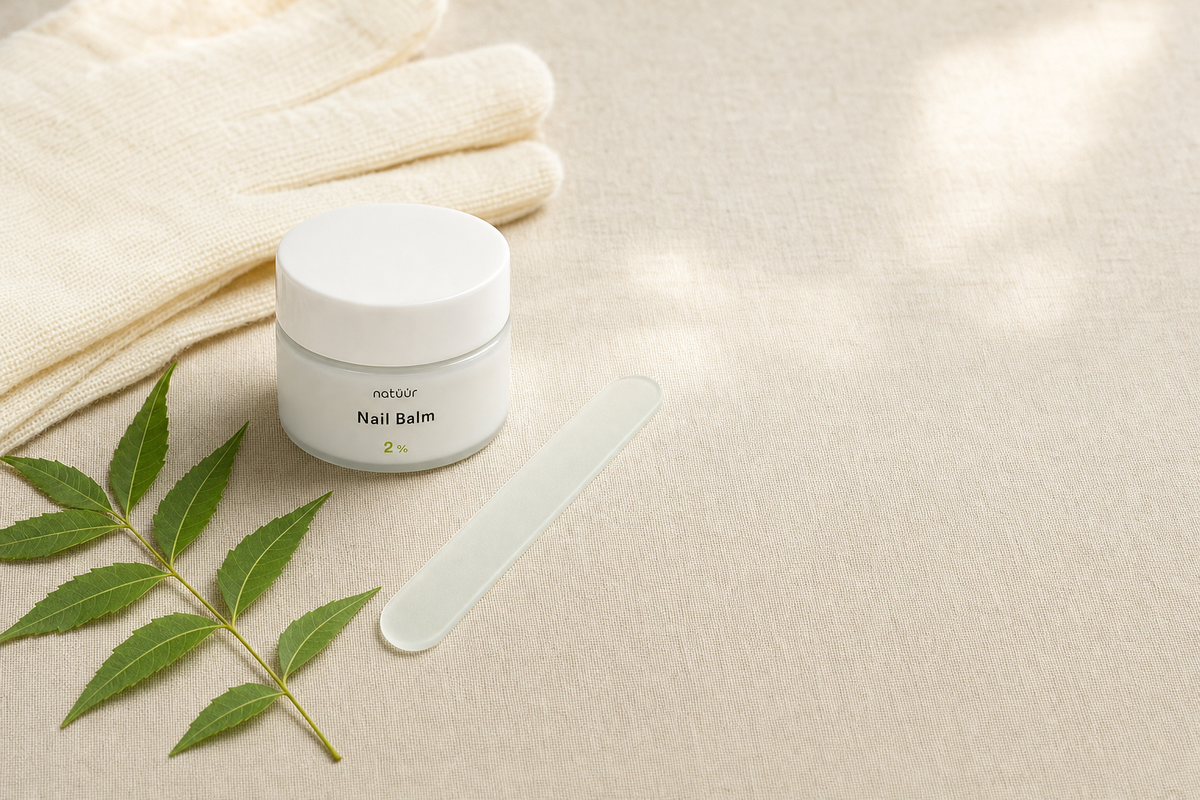
It's easier with ready-made care: the natüür Nail Balm is a water-free balm for cracked, brittle nails and irritated cuticles, with 2% NEEMAVERA® plus jojoba, macadamia and castor oil. Apply to nails and cuticles once or several times a day and massage in, overnight too if you like. Together with the light Nail Oil for daytime, it is available as the Nail Repair Duo, and you will find more options in our natural nail care. Important: care complements medical treatment, but does not replace it.

Nail psoriasis and psoriatic arthritis: why the joints matter
Nails and joints are more closely connected than you might think. Not figuratively, but anatomically: the extensor tendon of the fingertip joint runs directly into the area of the nail matrix. This makes the nail something like a window onto the joint. What you see on the nail plate above can be inflammation at the tendon attachment underneath.
Why nail psoriasis can be a sign of an increased risk of arthritis
Precisely because of this proximity, changes such as nail pitting, oil drops or separation from the nail bed are regarded in rheumatology as a sign that the joints could also be involved. Conversely, a great many people with psoriatic arthritis also have psoriasis of the nails. That doesn't mean it will happen to you. It means: it is worth paying attention before symptoms start. How psoriatic arthritis progresses, what rheumatologists look out for and which therapies are available is covered in the article When your joints hurt: everything about psoriatic arthritis.
Warning signs in fingers, toes, tendons and joints
These signals should be raised with a doctor, even if they seem harmless:
- a whole finger or toe swells up, evenly, sausage-shaped and tender to the touch
- stiffness in the hands or feet in the morning that lasts longer than half an hour
- pain at the attachment of the Achilles tendon or under the sole of the foot, especially with the first steps
- joints that are warm, swollen or painful at night without having been overused
When checked early, joint damage is more likely to be avoided. So: note down your symptoms with the date and put them on the table at your next appointment.

Living with nail psoriasis: shame, work and quality of life
Nails are small. Yet they are on show in almost every encounter: when shaking hands, paying, typing in a meeting. That is why many people with psoriasis of the nails eventually start curling their fingers in by reflex, putting their hands in their pockets or avoiding physical contact because they fear looks or questions. Then there is the practical side: crumbling nails and lifted nail plates can turn buttons, zips and handicrafts into a test of patience. How much of a burden this is has little to do with the size of the affected area.
How you can deal with visible psoriasis nails more confidently
The most common misunderstanding among colleagues: psoriasis nails are mistaken for contagious nail fungus. A matter-of-fact sentence takes away the other person's fear of contact faster than any hiding. For example: "This is psoriasis, a chronic inflammatory condition, not transmissible." It rarely takes more than that. It also helps not to push the emotional side aside, because tension and what happens in the skin are connected, more on this in the article on the mind and psoriasis. And if looking in the mirror weighs on you, the piece on self-acceptance is worth reading. You can dive deeper with the e-book "Leben mit Psoriasis".
When you should get support from a dermatologist
Not only when nothing else works. A check by a dermatologist is not cosmetic but medically sensible, because nail changes can point to joint involvement. A concrete next step: photograph your nails in daylight today and make an appointment.

Frequently asked questions (FAQ)
The questions about psoriasis of the nails that come up most often in dermatology practices and forums, answered briefly and without beating about the bush. You will find more answers about skin and skincare in the frequently asked questions.
What symptoms appear in the early stage of nail psoriasis?
Usually nail pitting comes first: tiny dents in the nail plate, as if someone had pricked it with a needle. Then yellowish-reddish spots that look like drops of oil under the nail, and the nail beginning to lift at the free edge.
What symptoms can nail psoriasis have as it progresses?
The nail plate thickens, becomes deformed and crumbles (crumbling nail). Keratin material collects under the nail, and the nail lifts over a large area. Pain when gripping or walking is added to this. Dermatologists record the severity with the NAPSI score.
What are the triggers of nail psoriasis flare-ups?
The predisposition is the basis, the trigger often comes from outside: mechanical irritation such as knocks, pressure from tight shoes, injuries to the cuticle, for example from cutting it away. Added to this are infections, severe stress and harsh chemicals, such as acetone-based remover. Sometimes a trapped finger is enough.
How can nail psoriasis be treated?
Depending on severity, topically with cortisone preparations, vitamin D3 analogues or medicated active-ingredient lacquers, and for stubborn cases with injections into the nail bed. If several nails are affected or the joints are involved, tablets or biologics may be considered. The choice is made by your dermatologist.
Is nail psoriasis contagious?
No. It is a chronic inflammatory condition in which the immune system drives inflammation, not an infection caused by fungi or bacteria. Nothing is passed on through shaking hands, towels or swimming pools. We clear up more half-truths of this kind in the psoriasis myths.
How long does it take for nail psoriasis treatment to work?
Longer than you would like. As a rough guide: fingernails take around half a year to grow out completely, toenails one to one and a half years. That is why an improvement only becomes visible on the newly growing section, usually after a few months.
Can I wear nail polish or artificial nails if I have nail psoriasis?
Normal polish to conceal changes is usually fine, ideally with an acetone-free remover and not permanently. Gel and acrylic nails are better avoided: filing, glue and UV curing irritate the nail matrix and can set off a flare-up via the Koebner phenomenon.
Which doctor should you see if you suspect nail psoriasis?
A dermatologist. There, the nail is examined and a swab or nail sample is used to check whether nail fungus is also present. Whether it is nail psoriasis or nail fungus determines the treatment, so guessing won't get you anywhere here.
Why is nail psoriasis often a warning sign for joint pain?
The nail matrix and the tendon attachment of the fingertip lie anatomically close together. If one becomes inflamed, the other is often affected too. Look out for swollen fingers or toes, morning stiffness and heel pain, and raise this early.