






Keratosis Pilaris (Chicken Skin): Causes, Care and What You Can Do About Rough Skin
In short: Keratosis pilaris (chicken skin) consists of small, rough keratin plugs in the hair follicles, usually on the upper arms, thighs, bottom or cheeks. It is harmless and not contagious, but it is hereditary and therefore cannot be cured permanently. What helps: daily, gentle care with urea (it only loosens keratin at higher concentrations), mild acids such as AHA, BHA or PHA, and a barrier-strengthening cream. Scrubbing, brushing and squeezing make it worse. The skin usually becomes visibly smoother after four to six weeks, and for many people it calms down on its own over the years.
What is keratosis pilaris? Recognising the symptoms on arms, legs and face
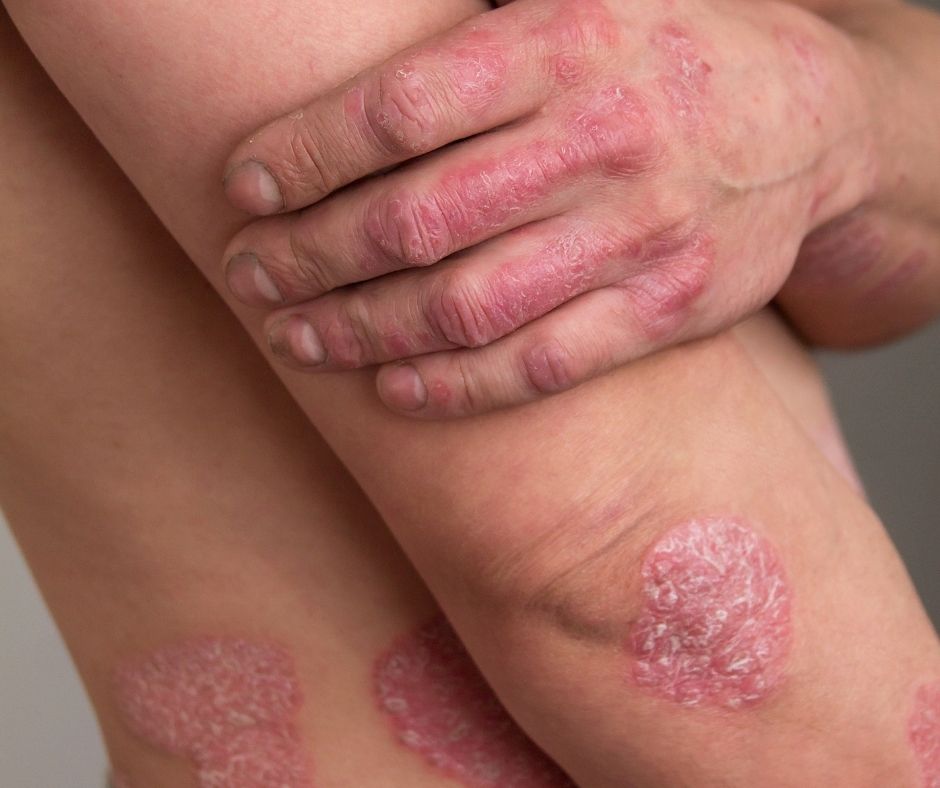
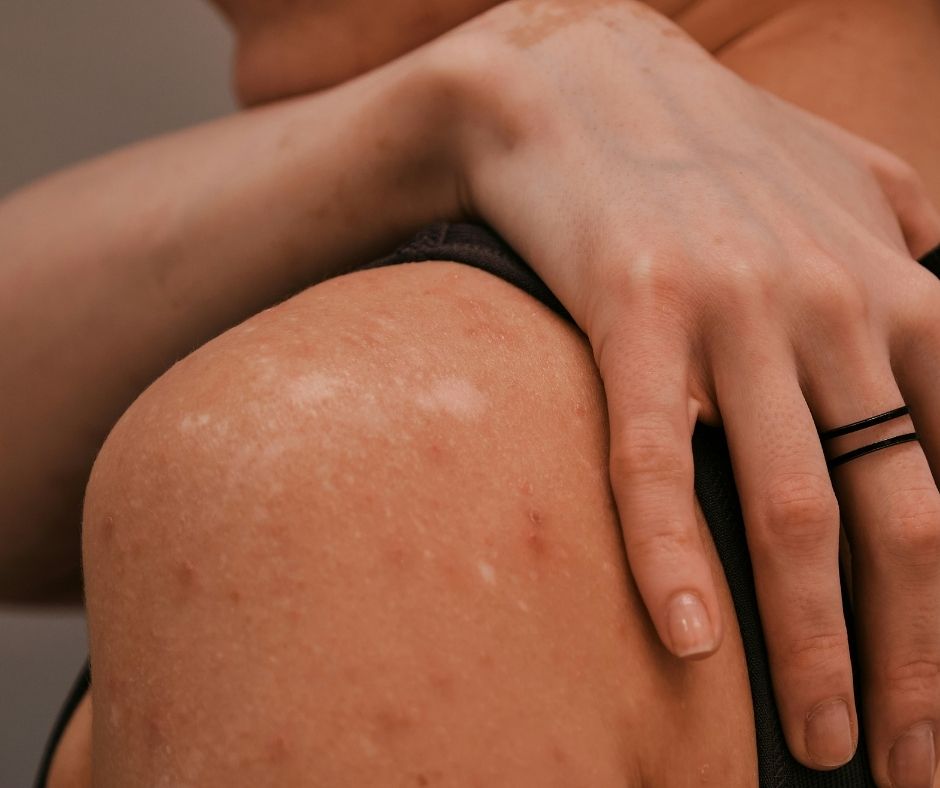
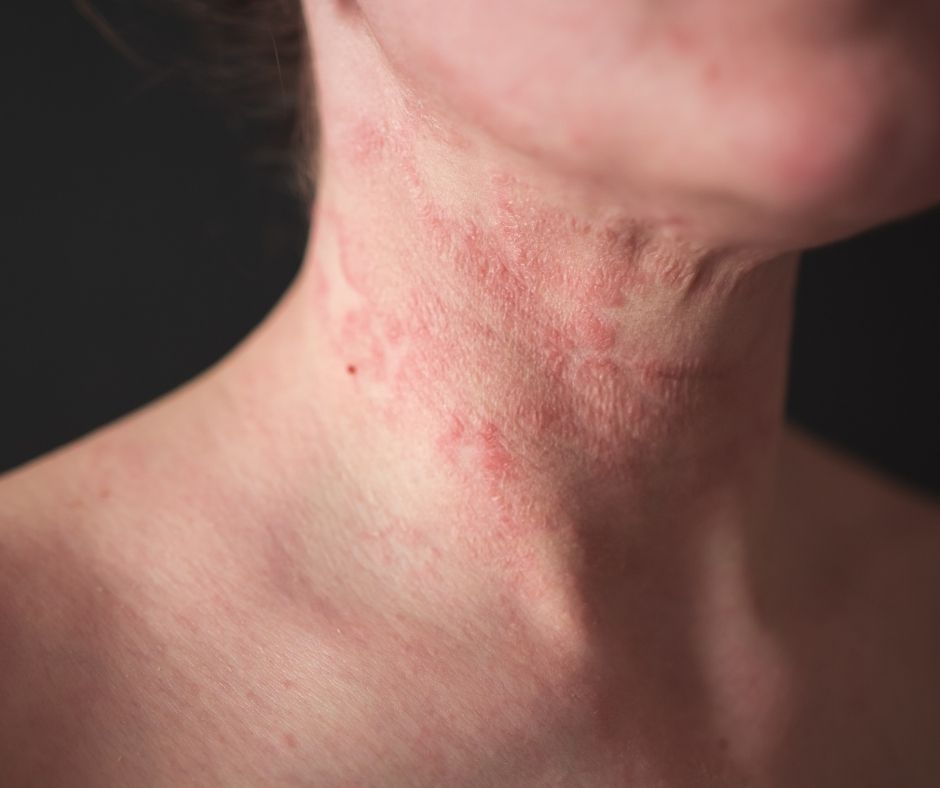
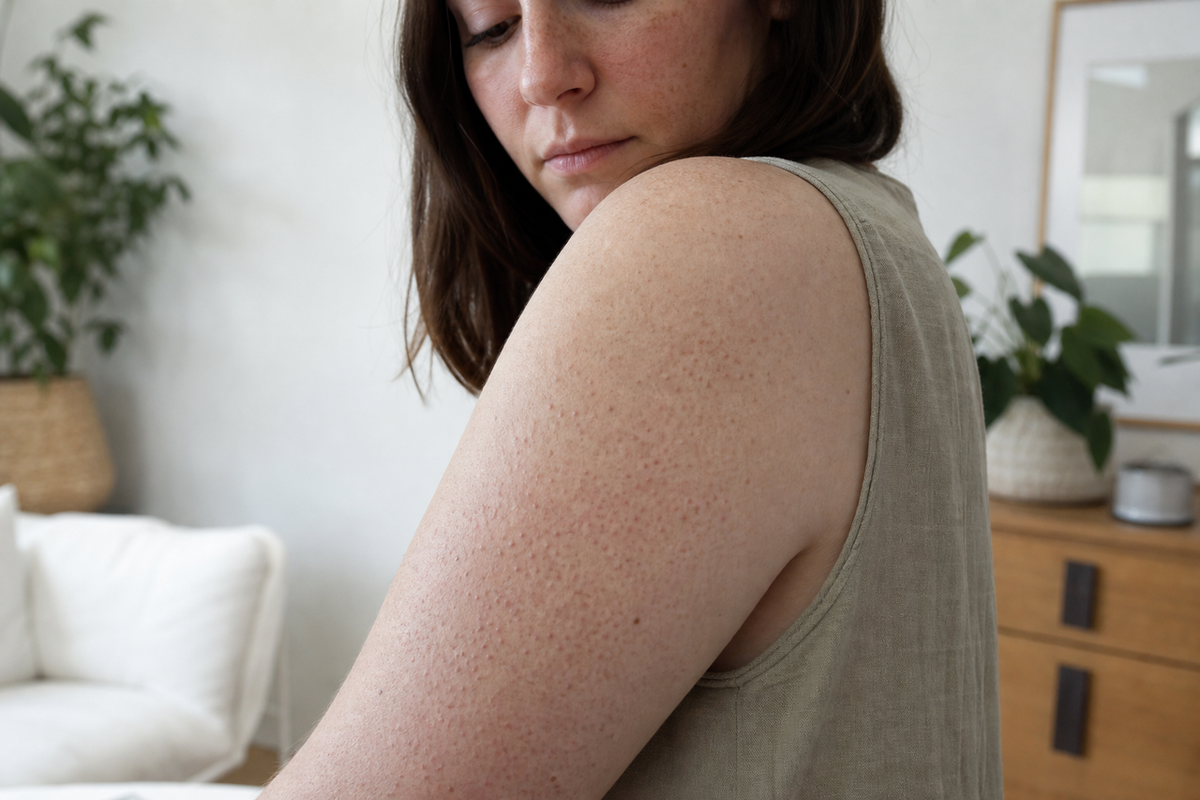
Rough little bumps on your upper arms that feel like fine sandpaper: that is chicken skin, known medically as keratosis pilaris. Behind it lies a keratinisation disorder at the hair follicle. Excess keratin, the structural protein of the horny layer, blocks the follicle opening and forms a hard plug. It is not contagious and not dangerous either, but it is pretty common: a large proportion of teenagers know this skin pattern, and for many it stays with them into adulthood. What stands out is its link to atopic tendencies, i.e. atopic dermatitis, hay fever or eczema.

Typical signs: rough skin on upper arms, thighs, bottom and cheeks
You recognise keratosis pilaris with your fingertips rather than your eyes. Small, raised bumps, each sitting exactly around a tiny hair, some skin-coloured, some with a reddish rim. Itching is rare. The distribution follows a pattern that almost always repeats itself:
- Outer sides of the upper arms: the classic spot, keratosis pilaris on the arms is the most common case
- Fronts of the thighs, often symmetrical on both legs
- Buttocks, where friction from clothing and sitting adds to it
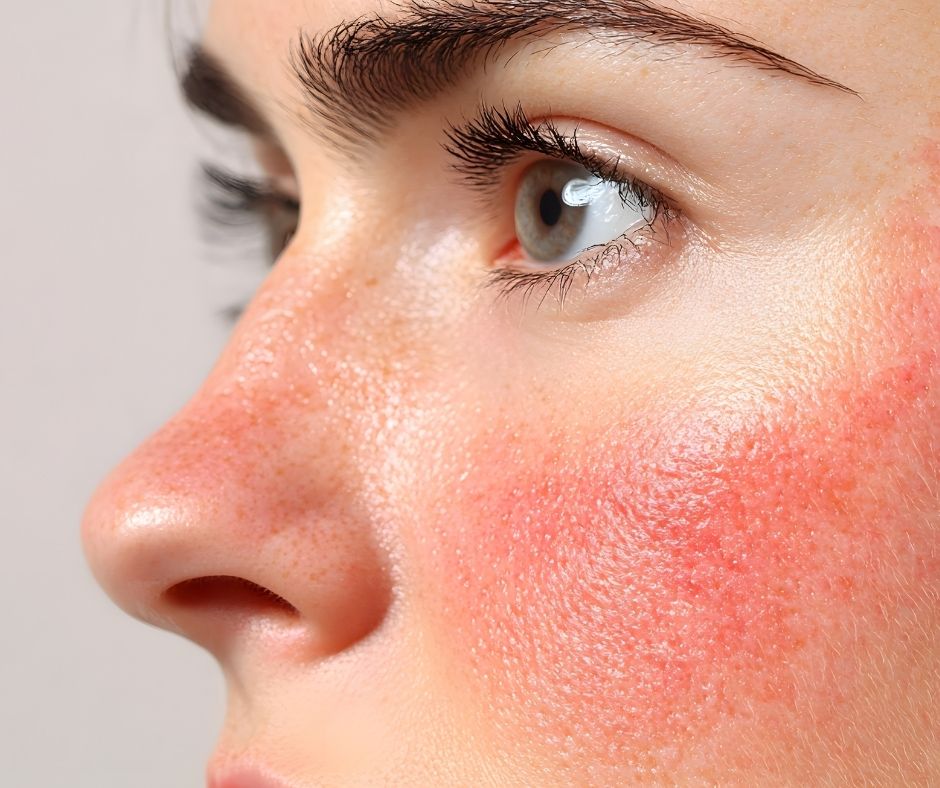
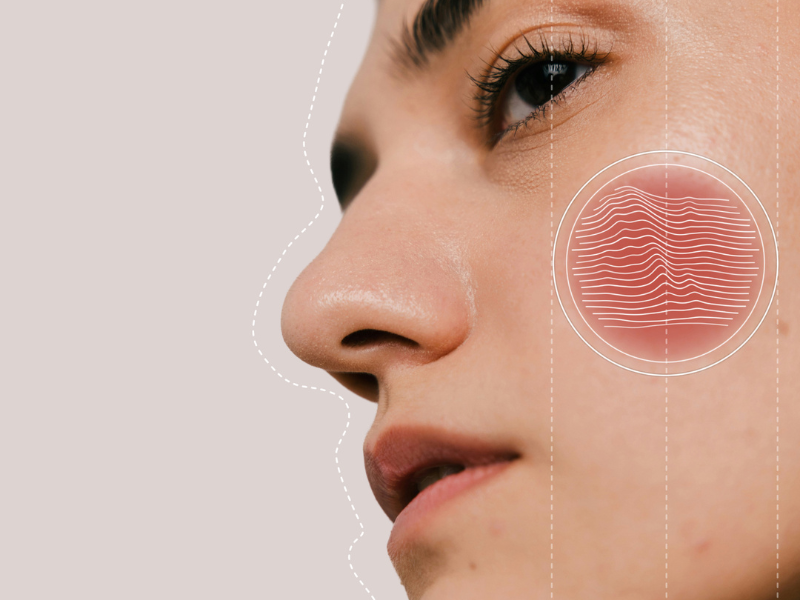
- Cheeks, especially in children and teenagers, then usually with widespread redness
In winter the picture usually becomes more pronounced, because heated indoor air and cold dry out the skin. In summer the surface smooths out on its own for many people. The predisposition remains all the same.

Keratosis pilaris or acne, strawberry legs and other skin conditions?
They are easily confused, and that has consequences for your skincare. The most important differences at a glance:

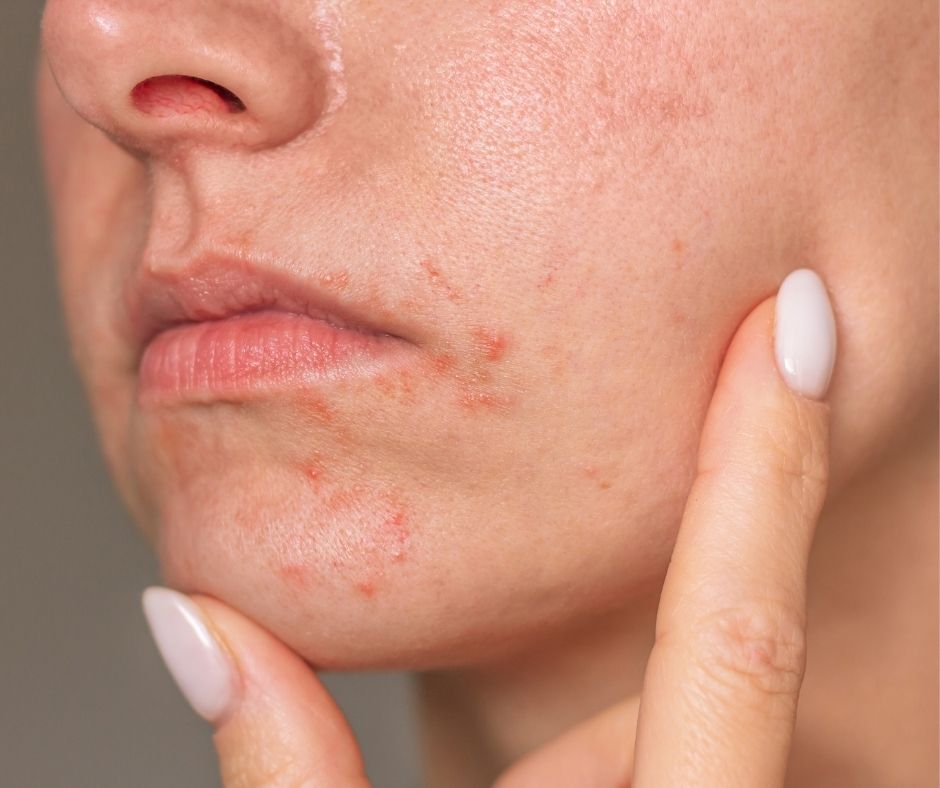
The costliest mistake happens on the face: if the rough cheeks are mistaken for acne, drying anti-spot products end up on the skin. The barrier suffers and keratinisation increases, which is exactly the opposite of what should actually help. If you are not sure whether it is keratosis pilaris or irritated, over-treated skin, the overview of common triggers of sensitive skin offers good pointers. And if in doubt, a dermatological assessment will clear it up in ten minutes.
Keratosis pilaris causes: what triggers it?
In short: it is in your genes. Keratosis pilaris is not the result of poor hygiene, it is not acne and not an allergy either, but a keratinisation disorder that is passed down in families. That explains why creams can smooth the skin, while the predisposition remains.
Keratin, blocked hair follicles and an impaired skin barrier
At its core is hyperkeratosis: the skin produces too much keratin, which blocks the entrance to the hair follicle and forms hard, horn-like plugs (American Academy of Dermatology (AAD), 2024). Picture a cork in the neck of a bottle. The hair underneath keeps growing but cannot get through, and sometimes it curls up. That is why the bumps feel like sandpaper under the skin, not like spots on top of it.
The predisposition is mostly inherited in an autosomal dominant way: if one parent is affected, the probability of passing it on is 50 per cent (National Center for Biotechnology Information (NCBI / NIH), 2023). The filaggrin gene, which controls how well the horny layer binds moisture, is under discussion here. If this building block is partly missing, the barrier holds on to water less well and the natural shedding of horn cells is sluggish. What the skin would normally get rid of by itself stays stuck at the follicle. You can read more about this mechanism in the article on the impaired skin barrier.
Why dry skin and winter make it worse
The body's own enzymes that detach horn scales from one another need water. If the stratum corneum is dry, they work less well, the scales stick and the bumps become more prominent. That is exactly what happens between October and March: cold air outside, heated air inside, and transepidermal water loss rises. Three everyday factors make this even worse:
- long, hot showers that wash out the skin's lipids
- indoor air below 40 per cent relative humidity
- skipping your skincare, because nobody sees the rough skin on your upper arms under a jumper anyway
You will find practical takeaways for the cold season in the tips on skincare in winter.
In puberty, adulthood and pregnancy
Hormones are the amplifier, not the trigger. Changes during puberty and pregnancy increase the cell renewal rate of the epidermis and alter sebum production, which encourages the follicles to become blocked (Mayo Clinic, 2024). Usually affected are the upper arms, thighs and buttocks, and in children the cheeks as well (DermNet NZ, 2024).

Keratosis pilaris in children and teenagers: gentle care without overdoing it
Children's skin is not a scaled-down adult body. The horny layer is thinner and the ratio of body surface to weight is larger, and that is exactly why more of an active ingredient ends up in a child's body than in yours. Keratosis pilaris often appears in the first years of life or becomes visibly noticeable with the onset of puberty. It frequently occurs together with dry skin or a tendency towards atopic dermatitis, and that is one more reason to make the care gentler rather than harsher.
How is keratosis pilaris treated in children?
The honest answer is: not at all in the sense of a therapy. What is treated is the dryness, not the predisposition. In concrete terms, that means showering lukewarm rather than hot and fairly briefly, cleansing gently without drying soap and then applying cream while the skin is still damp. It is unspectacular and still works most reliably. The little bumps on the upper arms do not dissolve through force, but through moisture and lipids in the horny layer.
Which active ingredients and concentrations are suitable?
The dividing line is age. The overview shows what makes sense for which age group and what you are better off leaving alone:

Every acid needs a counterweight: ceramide-rich, lipid-containing care afterwards, otherwise you trade rough skin for irritated skin. What such a pared-back routine looks like is explained in the article on natural care for sensitive skin.
When it gets teenagers down: shame, scratching and self-confidence
PE lessons, the short-sleeved T-shirt: there are moments when the upper arms are suddenly on show for everyone. Many teenagers are then ashamed of the bumps, think they are acne and squeeze them. The result is dark marks, sometimes small scars, and afterwards the skin looks more uneven than before. That is why understanding helps more than any cream: keratosis pilaris is not contagious, not a disease and not a hygiene problem. For many people it calms down on its own over the years. You will find thoughts on how to deal with it in the article on self-acceptance.
Getting rid of keratosis pilaris: what can you do about it?
The uncomfortable answer comes first: you cannot cream keratosis pilaris away, but you can smooth it. The difference sounds like hair-splitting, but it decides whether you give up in frustration after four weeks or stick with it. The symptoms can be treated, the predisposition cannot.
Realistic expectations: can keratosis pilaris be cured completely?
No, it cannot. And any product that promises you that is selling you a story rather than a solution. The predisposition sits in the genes, while skincare only works on the surface. A fitting comparison: the routine is like brushing your teeth. It keeps things in check for as long as you do it. If you stop, the rough little bumps on your upper arms and thighs come back after a few weeks, usually to exactly the same extent as before.
The good news: for many people the skin calms down over the years, because the skin's moisture and sebum regulation changes. Until then, consistent care is the lever you actually have in your hands.
Skincare routine: cleanse, exfoliate, moisturise
It is three steps, not twelve. What matters is the order, not the number of jars in your bathroom.

For large areas such as rough skin on the upper arms and thighs, you need a texture that spreads quickly, for example a mild, lipid-replenishing Body Care Routine as the nourishing building block in the last step. The work of loosening the keratin is done by the acids and urea; more on that in the next section.
And then, above all, you need one thing: patience. The change only becomes visible after several weeks of daily use, not after the third shower. A concrete start for tonight: swap your shower gel for a syndet, halve your shower time and then apply cream within three minutes. If you are not sure which texture suits your skin condition, the free AI skin analysis will help you work it out.
Active ingredients for keratosis pilaris: urea, acids and barrier care
The logic of active ingredients for keratosis pilaris has two parts: something loosens the keratin plugs in the follicle opening, and something else holds the barrier together afterwards. Only both together make a sensible routine; if you only have one of the two, you end up with either rough or irritated skin.
Urea: 5 to 10 per cent against rough keratinisation
Here it is worth taking an honest look at the concentration. Urea only has a keratolytic, i.e. keratin-splitting, effect from about 10 to 20 per cent, because that is when the hydrogen bonds in the keratin are broken. 5 to 10 per cent mainly works as a moisturising Natural Moisturizing Factor (Journal of Clinical and Aesthetic Dermatology, 2021). For a 20 per cent urea cream applied twice daily for four weeks, a significant smoothing of the skin texture and a reduction in follicular papules has been shown (Journal of Dermatological Treatment, 2020). In other words: the 5 per cent lotion does not loosen keratinisation, it is simply moisture. That is good too, just something different.
AHA, BHA and PHA: gentle exfoliation instead of scrubbing
Lactic acid as an AHA only has a clear keratolytic effect on keratin plugs from around 10 per cent; lower doses mainly buffer the pH and retain moisture (Journal of Cosmetic Dermatology, 2019). Salicylic acid (BHA) is fat-soluble and can therefore get into the oily follicle. PHAs such as gluconolactone have larger molecules, penetrate more slowly and are the less irritating option. What you can skip, on the other hand, are pumice stones and coarse grains. Such micro-injuries actually make keratosis pilaris worse via the Koebner effect (American Academy of Dermatology, 2023).
The following overview shows which group of active ingredients does which job:
| Group | Job | Note |
|---|---|---|
| Urea 10–20 % | Keratolysis | can sting |
| Urea 5–10 % | Moisture | NMF, not an exfoliant |
| AHA/BHA/PHA | chemical exfoliation | PHA is the mildest |
| Barrier care | Lipids, soothing | daily |
Keratolytics without a counterpart of lipids and soothing substances damage the barrier, and that is exactly what the third column in the table is about.
Ceramides, niacinamide and panthenol for the skin barrier
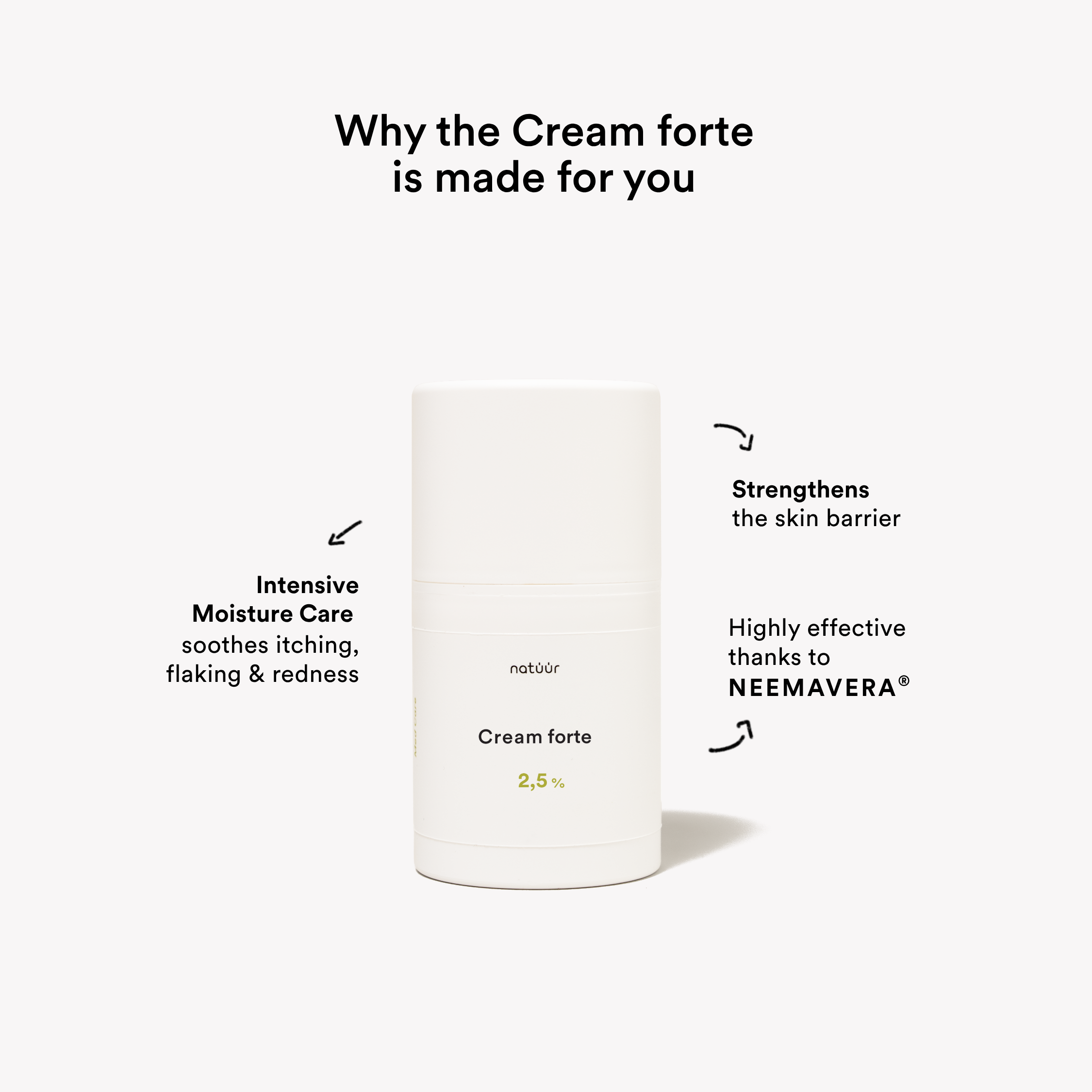
Ceramides and fatty acids lock moisture into the skin, niacinamide supports the barrier, and panthenol soothes the irritated follicle edges that can develop after using an acid. This is exactly where natüür is at home, too. The formulations are deliberately not keratolytic, but rely on nourishing, barrier-strengthening active ingredients: on NEEMAVERA® (2.5 per cent in the Cream forte, more on its effect on the skin), on lipid-replenishing plant oils such as shea, olive and almond oil, and on panthenol and allantoin. The care is designed to nourish and support skin that tends towards keratinisation and gets irritated easily: the Body Lotion works well for larger areas on the upper arms and thighs, while the Cream forte is made more for individual rough patches. The lactic acid contained in these formulations serves solely to adjust the pH value. So it does not loosen any keratin plugs. You can read all about this in our ingredients overview.

Keratosis pilaris skincare mistakes: what you are better off avoiding
Most flare-ups of keratosis pilaris do not come from too little care. They come from too much. If you try to scrub the bumps away, you are working against the biology of the skin: friction is a stimulus for the epidermis, and it responds to stimuli with more horny layer. So the scrub does work, just in the wrong direction.
Mechanical scrubs, brushes and squeezing
Abrasive particles such as ground nutshells or coarse sea salt cause micro-injuries in the top layer of the skin. The skin repairs itself, thickens and builds new keratin, exactly where the follicle entrance is already blocked. Body brushes and rough gloves work on the same principle, just every day. And squeezing? The keratin plug sits in the follicle canal, not on top. If you pick at it, you tear the follicle wall: inflammation, dark marks after healing and secondary bacterial infections are the typical result.
These things are reliably bad for the rough skin on your upper arms and thighs:
- scrubs with abrasive particles, whether sugar, salt or nutshell
- dry brushing on the areas with keratosis pilaris
- squeezing, scratching or picking at the papules
- loofahs, copper scourers and callus planes on the body
The alternative is chemical rather than mechanical: keratolytics loosen the bonds between the horn cells without pulling on the follicle. How to tell that your routine is too harsh overall is explained in the article on the 5 signs of overly aggressive skincare.
Hot showers, drying soaps and hair removal
Hot water dissolves lipids from the skin barrier; ceramides and free fatty acids go down the drain. Afterwards the skin loses more water to the outside, becomes drier, and dryness increases keratinisation. It is better to take short, lukewarm showers and then apply cream while the skin is still damp.
Classic household soap is in the alkaline range, whereas the skin's acid mantle is at around pH 5. The difference is not a detail: the skin's own enzymes that detach dead cells need the acidic pH. A mild syndet is the easier lever here. Which form suits you is explained in the comparison bar soap vs. liquid soap, and which irritants you should avoid in the list of 10 ingredients to avoid for sensitive skin.
Waxing and epilating pull at the keratinised follicle, the wall tears and the regrowing hair grows inwards. If you shave, then please never dry and never against the direction of growth, but with a sharp blade and plenty of lubricant. Your next step for today: turn down the shower temperature and take the brush out of the shower.

Diet, home remedies and everyday life with keratosis pilaris
Skincare is one lever. The other lies in everyday life: what ends up on your plate, what is on your bathroom shelf and what rubs against your skin all day. Keratosis pilaris does not disappear because of it, but it becomes calmer, or louder.
Does diet help? Nutrients, myths and limits
The honest answer is: not much directly. Keratosis pilaris is an inherited keratinisation disorder of the hair follicles, not a deficiency. A severe vitamin A deficiency can trigger follicular hyperkeratosis, but with a balanced diet that is practically not an issue. And elimination diets without a diagnosed intolerance have no proven effect on the bumps. The anti-inflammatory direction makes more sense, i.e. omega-3 fatty acids, antioxidants and drinking enough. If you want to dig deeper, you will find plenty on the interplay between digestion and skin in our article on the underestimated power of the gut for the skin. Don't expect smooth upper arms from linseed oil.
Home remedies for keratosis pilaris: apple cider vinegar, coconut oil and baking soda put to the test
Three classics from the kitchen cupboard, three very different risks. The table shows what each approach does to the skin barrier:

So coconut oil is not a mistake, just not a keratolytic: it moisturises the surface but does not loosen the keratin plugs. If oils are your thing, our guide to plant oils for the skin shows you which oil suits your skin. Baking soda, on the other hand, is best crossed off the list altogether. Your skin's pH is in the slightly acidic range, a baking soda paste raises it, and the barrier loses water as a result. Afterwards the skin is rougher than before, but at least it is clean.
Clothing, humidity and friction: everyday tips
Constant friction from tight jeans or synthetic fibres can further irritate the follicle openings and make the rough patches worse. That is easy to change:
- Loose cotton or linen over upper arms and thighs, especially at night
- Keep indoor air at around 40 to 60 per cent in winter; a hygrometer costs less than 15 euros
- Change out of sportswear straight after training instead of letting it dry on you
- Pat dry after showering, don't rub
When should you see a dermatologist about keratosis pilaris?
Keratosis pilaris is harmless. But that does not mean it always looks harmless. There is a fairly clear point at which self-care reaches its limits: a visit to the dermatologist is advisable if severe redness, inflammation, itching or hyperpigmentation occur, or if over-the-counter keratolytics have no effect after around 8 to 12 weeks. Eight weeks is a long time, that is true. Unfortunately, a keratinisation disorder cannot be assessed in less time.
The second reason is the diagnosis itself. Not all rough skin on the upper arms is keratosis pilaris. Lichen spinulosus, folliculitis, phrynoderma due to vitamin A deficiency or acne vulgaris look similar and need different treatments. If you guess wrong here, you will spend months applying cream against the wrong problem. A dermatological assessment clears this up in one appointment.
Medical treatment for keratosis pilaris: retinoids, compounded preparations and laser
In practice, three levers are available, each working at a different point:
| Procedure | Target | Proven effect |
|---|---|---|
| Topical retinoids (tretinoin, adapalene, tazarotene) | Cell renewal, blocked follicles | Opens the pores, prescription-only |
| Chemical peels, high-dose fruit acids | Rough texture | Combination with laser most satisfactory according to clinical practice |
| Pulsed dye laser, IPL | Persistent redness (keratosis pilaris rubra) | Redness clearly decreases over several sessions |
Retinoids speed up cell renewal and open blocked follicle openings. Laser and light therapy, on the other hand, target the blood vessels, not the horny layer: with treatment-resistant redness, it can clearly decrease over several sessions. The bumps can still be felt, though, because laser does not smooth keratinisation, it only takes out the colour.
How long does it take for skincare to show first results?
It usually takes several weeks of daily use, often four to six, before keratolytic care shows visibly in smoother skin. And it doesn't stop there: after stopping, keratosis pilaris comes back within a few weeks for most people. Keratosis pilaris cannot be cured permanently; it is an ongoing issue with reduced maintenance care.

Frequently asked questions (FAQ)
These short answers add points to the sections above that are not covered there in detail. You will find more questions about skincare and ordering in the frequently asked questions.
Does keratosis pilaris go away on its own with age?
Often, yes. For many people the skin calms down from their twenties onwards, because sebum and moisture regulation change. That is not a guarantee. Until then, your skincare decides how rough your arms feel.
Can keratosis pilaris occur during pregnancy?
Yes. Fluctuations in oestrogen and progesterone affect epithelial growth, which is why keratosis pilaris can appear for the first time or get worse. After giving birth and breastfeeding, the skin settles down again for many women.
Is keratosis pilaris contagious or dangerous?
No. It is neither contagious nor harmful to health, but a cosmetic change based on a predisposition. You cannot pass it on to anyone, nor spread it to other parts of your body.
Is it OK to squeeze the little spots of keratosis pilaris?
Better not. Squeezing and scratching increase the risk of dark marks (post-inflammatory hyperpigmentation) and of bacterial infections, for example with Staphylococcus aureus. And it still won't loosen a plug. Chemical exfoliation is the safer way.
Does sun or a sunbed help with keratosis pilaris?
In the short term, UV has a slightly anti-inflammatory effect; in the long term, the skin builds up a light callus: a thicker horny layer and even narrower follicles. A sunbed brings no benefit and increases the risk of skin cancer.
Can keratosis pilaris be lasered at the dermatologist's?
Vascular lasers such as PDL or KTP can reduce the accompanying redness; the rough texture remains. That is not a cure, and skincare remains a must. If a product does not suit your skin, our satisfaction guarantee applies.